Showing posts with label Clonmacnoise. Show all posts

Sunday, August 18, 2019

Daphne D.C. Pochin Mould: geologist, historian, archaeologist and travel writer


Daphne D.C. Pochin Mould: 
geologist, historian, archaeologist and travel writer

Niall C.E.J. O’Brien

In November 2010 Daphne Pochin Mould celebrated her ninetieth birthday and a remarkable life well lived. But at a time when other people would be winding down Daphne was planning her next project – a book on Cork’s first newspapers, the Hibernian Chronicle and Cork Mercantile Chronicle which ran from 1769 to 1815.[1]

Pochin Mould (photographer unknown)

Early life

Daphne Desiree Charlotte Pochin Mould was born in Salisbury in 1920 but lived in Ireland since 1951 and was living for a time in Scotland before that. As Daphne said “My background is English, but I have been so long out of contact with its thought and way of life, that going back there in recent years, I found I passed for a born Irishwoman.”[2] 

Daphne’s young life in Salisbury was free for exploration as she said that she was lucky to “escaped formal early education” but this was no drawback for someone who went on to become an author, photographer, broadcaster, geologist, traveller, pilot and Ireland’s first female flight instructor. Daphne has always had an interest in machines and matters mechanical. At 17 years old she took her driving test and passed with flying colours and as she said “I have been addicted to cars ever since.”[3] Fortunately for the wider archaeological community Daphne Pochin Mould also had an addiction to planes and became a well-known and respected aerial photographer. In later years she kept a single engine Piper Cub at Cork Airport and was still flying up until her last years. During the Second World war Daphne Pochin Mould attended Edinburgh University and qualified with a PhD in geology along with a research fellowship.[4]

Scotland

After University, Daphne Pochin Mould went on a spirit of adventure to settle in the Hebrides, where she learnt to become a crofter as well as writing on the islands (The Roads from the Isles and West over Sea). Her PhD was studying the rocks of the Scottish Highlands and the Hebrides was not that far off the beaten track.[5] Her new neighbour, Sandy Grant, taught her to make hay and use a scythe to cut corn. The fast fading townie also learnt to harness a horse to a cart and do ploughing and harrowing.[6] 

But the farming landscape of the Hebrides didn’t ground her mind to the soil but opened it to the wider world. One of her earliest published books was the Scotland of the Saints which recounted in a popular but scholarly way the coming of Christianity to Scotland. Using her geology qualifications Daphne explored Scotland to say why they built the sites of early abbeys and churches in the places that they did. The book combined this exploration with geographical and historical data to produce a nice book complete with a map and over 50 photographs.[7] Daphne Pochin Mould was brought up in the Anglican Church but developed into a militant agnostic. Her intention to write the book on the Scottish church was to attack the Church but the journey of exploration actually took her into the Church. In 1950 she was received into the Catholic Church by the Benedictines of Fort Augustus.[8]

Ireland of the saints and scholars calls Daphne

In 1951 an interest in early Celtic saints brought Daphne to Ireland where she took up residence at Aherla, in mid-Cork. Many years later a book dealer recounted a story of how he went to Aherla to meet Daphne Pochin Mould about 2012 and found the door ajar of the old rectory where she lived. The dealer and his wife slowly walked in but the house showed no sign of life. Then they heard a distant tap, tap, tap, from somewhere deep inside the house. No wishing to disturb Daphne in her time of intense writing the couple quietly retraced their steps out of the house.[9] Writing was an important part of Daphne’s eventful life. As she once recounted, “I do not really remember when I did not want to write. I remember composing stories and poems before I learned to write and dictating them to members of the family who wrote them down for me.”[10] 

The book Ireland of the Saints

In 1953 Daphne Pochin Mould published her first on many books about Ireland. Entitled Ireland of the Saints the work explored the Ireland before Christianity and the impact the new religion had on the country. With chapters on the principal saints like St. Patrick, St. Brigit, St. Columcille, and St. Brendan the book examine the new religion in terms of male and female prospectus and how Christianity was moulded into the Irish way through the monasteries and how then the Irish took Christianity back into Europe with their love of travel and learning. In the preface Daphne said that it was “perhaps a rash undertaking for an incomer to Ireland” to write the book but she acknowledged the use of previous researches by other scholars, listed in a bibliography. Most of the photographs used in the book where taken by other people, including the aerial photos. Daphne’s own photos took her around the country to Inismurray, Ahenny, the stone chapel of St. Macdara in Connamara and the Aran Islands.[11]


The book The Mountains of Ireland

The Ireland of the Saints included a number of photographs of Irish mountains associated with Christian saints. These photographs and Daphne’s own training in geology made a project on the mountains of Ireland a venture not to be missed. Published in 1955, The Mountains of Ireland was described as the first book to explore the Irish mountains – it possibly takes an outside to see the beauty that long residents take for granted. The book describes the geology, customs and place-names that surround the Irish mountains with a climbers guide to the best ways of visiting and ascending and how to descend again. The book was illustrated with over fifty photographs but only three by the author (Mayo, Connamara and upon the Twelve Bens of Galway). Photography was a young science for Daphne but she would soon master it and take it to new heights!

Other books

After the book, Ireland of the Saints, Daphne Pochin Mould published another two books on Irish Christianity entitled The Rock of Truth and The Celtic Saints: Our Heritage.


The book Irish Pilgrimage

In 1957 Daphne Pochin Mould publish another book on Irish Christianity called Irish Pilgrimage. This book included twelve photographs taken by Daphne on her journey from Ballyvourney to Mount Brandon and the Reask cross pillar stone to Clonmacnoise and Glencolumbkille and St. Mullins by the River Barrow.[12]  


The book The Irish Dominicans

Also in 1957 Daphne Pochin Mould found time published a second book, this time on a general history of the Irish Dominicans over seven hundred years. On Ash Wednesday 1952, at Galway, Daphne was received into the Dominican Third Order. Her book as a general history was not the detailed history of the Order which Dominic O’Daly asked for in the seventeenth century but Daphne hoped it would act as a starting point for some future scholar to conduct a detailed examination. Daphne was aided in her researches by Luke Taheney, O.P., who found many forgotten fragments of Dominican history.[13] The fourteen chapters and fourteen appendices were inter-spaced with eighty-three photographs of which forty-seven were taken by Daphne.[14] The Irish Dominicans was described by a later historian of the Dominican Order as an “eminently readable” book.[15] 

Other books

After the extensive output of published books in the 1950s Daphne Pochin Mould continued with her exploration of her new country and published nearly twenty books to share her discoveries with the wider public.[16] These books included The Aran Islands (1972), The Mountains of Ireland (1976).[17] In 1988 Daphne Pochin Mould went in exploration of a different form of travel with her book on Captain Roberts of the Sirius.

Aerial photography

Aerial photography of archaeological monuments began in Northern Ireland in 1927 and was first used in the Republic in 1934. In 1951-3 and 1963-73 Professor St. Joseph of the Cambridge University Committee for Aerial Photography took a series of photos from across Ireland for the National Monuments Council.[18] Daphne Pochin Mould was excited by this new view on archaeology and secured a pilot’s licence. She would go on to become Ireland’s first female flight instructor.[19] Much of her work in aerial photography was in the south of Ireland and although most of her photos were not published, some did enter the public arena. In the 1980s the Cork Archaeological Survey took on Daphne as their aerial photographer. In a photo of the Survey team in 1984 Daphne looked a bit lost in the group of younger people but a later reunion photo had her among the group standing proud.[20] Daphne’s activities helped encourage other female archaeologists like Gillian Barrett to take to the air and expand the range and density of Irish archaeology sites.


The book Discovering Cork

In 1991 Daphne Pochin Mould published a book exploring and discovering her adopted county – Cork. The book explores the county through its monuments of the centuries from megalithic structures to Christian churches, medieval castles and monasteries to modern canals, roads and industrial sites. It is full of photographs and information with an extensive bibliography.

Honorary Doctorate

In 1993 Daphne Pochin Mould’s work as "a scientist and a free spirit, a courageous pioneer and an outstanding woman warrior", was acknowledged with an honorary doctorate from University College Cork.

Final years and death

Daphne Pochin Mould was active up to the end writing and travelling. In 2011 she stayed for a few days at the Walter Raleigh Hotel in Youghal where she was visited up by a number of local historians. They were delighted to hear her stories and enjoy the atmosphere. Unfortunately due to other commitments this author was not able to join the fun.

Daphne Desiree Charlotte Pochin Mould died on 29th April 2014 after a short illness.[21] Daphne Pochin mould travelled far in a long life – from Salisbury to Scotland to Aherla in Co. Cork – from geology to history and aerial photography – from Anglican to the Catholic faith – she truly went on an Irish Pilgrimage.

==============

End of post

=============


[1] Unfortunately the book didn’t make it to the publishers before her death in 2014
[2] Irish Examiner, 15th November 2010, Dan Buckley article on Daphne Pochin Mould
[3] Irish Examiner, 15th November 2010, Dan Buckley article on Daphne Pochin Mould
[4] Irish Examiner, 15th November 2010, Dan Buckley article on Daphne Pochin Mould
[5] Pochin Mould, D.D.C., The Irish Dominicans: The Friars Preachers in the history of Catholic Ireland (Dublin, 1957), dust jacket
[6] Irish Examiner, 15th November 2010, Dan Buckley article on Daphne Pochin Mould
[7] Pochin Mould, D.D.C., Ireland of the Saints (London, 1953), p. 4
[8] Pochin Mould, D.D.C., The Irish Dominicans: The Friars Preachers in the history of Catholic Ireland (Dublin, 1957), dust jacket
[9] Information recounted to the author c.2012 at the Lismore antiques fair
[10] Irish Examiner, 15th November 2010, Dan Buckley article on Daphne Pochin Mould
[11] Pochin Mould, D.D.C., Ireland of the Saints (London, 1953), p. 8
[12] Pochin Mould, D.D.C., Irish Pilgrimage (New York, 1957), p. ii
[13] Flynn, T., O.P., The Irish Dominicans 1536-1641 (Dublin, 1933), p. xx
[14] Pochin Mould, D.D.C., The Irish Dominicans: The Friars Preachers in the history of Catholic Ireland (Dublin, 1957), pp. xiii-xvi
[15] Flynn, T., O.P., The Irish Dominicans 1536-1641 (Dublin, 1933), p. xx
[16] Other books included The Celtic saints, our heritage (1956), Peter's boat: A convert's experience of Catholic living (1959) The Lord is Risen: The Liturgy of Paschal Time (1960), Angels of God: their rightful place in the modern world (1963), The Second Vatican Council (1963), Whitefriars Street Church: A Short Guide (1964), Saint Brigid (1964), Saint Finbarr of Cork (1965), A book of Irish saints and Irish saints' names (1965), Ireland; From the Air (1973) and Valentia: Portrait of an Island (1978)
[17] Pochin Mould, D.D.C., Discovering Cork (Dingle, 1991), dust jacket
[18] Lambrick, G., Air and Earth: Aerial archaeology in Ireland (Dublin, 2008), p. 13
[19] Irish Examiner, 2nd May 2014, Dan Buckley article on Daphne Pochin Mould
[20] Power, D., ‘The Cork Archaeology Survey’, in Emer Condit (ed.), Surveying Our Heritage: The National Monuments Service: marking 50 years of the Archaeological Survey of Ireland (Dublin, 2013), pp. 22-23
[21] Irish Examiner, 2nd May 2014, Dan Buckley article on Daphne Pochin Mould

Friday, December 30, 2016

Clonmacnoise: a pictorial tour

Clonmacnoise: a pictorial tour


Niall C.E.J. O'Brien


The monastic and episcopal site of Clonmacnoise holds a special place in the hearts and minds of Irish people and those who follow the ecclesiastical history of the country. I first visited Clonmacnoise in the mid 1990s arriving near dawn in the month of May. The sun was just brightening the eastern sky. The first image to strike my senses was not the architectural riches of Clonmacnoise but birds singing across the broad expanse of the River Shannon and the flat country beyond to the north and west. For a person who comes from a part of Ireland of hills and valleys the flatness of the countryside was like a different world. But it was the birds that day that felt my heart and they have always reminded me of Clonmacnoise wherever I hear the small birds sing.

When I returned in 2016, towards evening time of a September day, the birds were just heading off home while the beauty of the broad River Shannon flowed by. On that day I approached the monastic site from the east, along a straight road but one full of inclines and declines so that Clonmacnoise almost comes upon you without warning. I didn't have a camera on my first visit but made up for it on the second. This article is as much as pictorial tour, as the title says, of Clonmacnoise rather than the detailed history articles that I am use to but then Clonmacnoise is a different world!


Introduction

The monastery at Clonmacnoise was founded in the sixth century by St. Ciaran. St. Ciaran was educated by St. Finnian of Clonard and St. Enda of Aran and was listed among the ‘twelve apostles of Ireland’. Within a short time Clonmacnoise became one of the important religious centres in pre-Viking Ireland. This was due to the personalities of its abbots and its famous school where many famous manuscripts were made such as the Annals of Tighernach (11th century) and the Book of the Dun Cow (12th century). Clonmacnoise was also well served by its location at the centre of Ireland with the River Shannon giving easy communication north and south and the Esker Riada for east-west travel. The river location also brought trouble as Clonmacnoise was plundered at least six times between 834 and 1012. Of more economic harm the monastery suffered destruction by fire 26 times between 841 and 1204. [Peter Harbison, Guide to National and Historic Monuments of Ireland (Gill & Macmillan, Dublin, 1992), p. 276]


Possibly because of the conservative views of the abbots of Clonmacnoise and other political influences, Clonmacnoise was not recognised as the cathedral church of a diocese at the synod of Rathbreasail (1111). Later it was recognised as the centre for the new diocese of West Meath with Clonard as the centre for the diocese of East Meath. Yet no bishop is known by name until 1148 and Muidchertach O Maeluidhir. Sometime after 1174 the diocese of Clonmacnoise was transferred from the province of Tuam to that of Armagh. After the Norman invasion the new Bishop of Meath pushed the Bishop of Clonard westwards at the expense of Clonmacnoise. By the mid-thirteenth century the diocese was reduced to a small area east of the River Shannon. Thus Clonmacnoise, rich in architectural and natural beauty became one of the poorest dioceses. [A. Gwynn & R.N. Hadcock, Medieval Religious Houses Ireland (Irish Academic Press, Blackrock, 1988), p. 64]

To add to its decline and economic troubles Clonmacnoise was often plundered in medieval times beginning in 1179 when the Normans attacked. In 1552 the English garrison from Athlone attacked the site and removed all the monastic valuables they could find. From that time Clonmacnoise never recovered. [Peter Harbison, Guide to National and Historic Monuments of Ireland (Gill & Macmillan, Dublin, 1992), p. 276]


The wide River Shannon as it passes by Clonmacnoise


Clonmacnoise as seen from the river bank 


Northern view of the churches of Clonmacnoise

==========

Teampull Finghin

On the northern boundary wall of the Clonmacnoise site is the twelfth century nave and chancel of Teampull Finghin. the Romanesque chancel arch is a fine example. It appears that the nave and chancel were built at the same time. At a different time a round tower was built onto the south side of the church. [Brian de Breffny & George Mott, The Churches and Abbeys of Ireland (Thames & Hudson, London, 1976), p. 41]

Teampull Finghin with its attached round tower

Teampull Finghin chancel arch and nave in foreground


Teampull Finghin chancel arch

West archway/window with Temple Connor and the round tower beyond

==============

Clonmacnoise cathedral

Clonmacnoise was recognised as the centre of a diocese in the early twelfth century and so needed a cathedral church to display its new status. The building that was adopted as the cathedral already a standing church long before that time and was even described as restored in 910 which would make its actually construction much earlier. The cathedral appears to be the building referred to as the daimliag or stone church.

The west doorway as seen today is a fine example of a Romanesque doorway but it is a reconstruction. Plate four of Roger Stalley’s study on Irish high crosses shows the arch under reconstruction with another broad arch clearly visible above the doorway and extending beyond the doorway [Roger Stalley, Irish High Crosses (Country House, Dublin, 1996), p. 20]. The smaller and newer Romanesque west doorway is dated to the fifteenth century when about the same time the chancel area was divided into three vaulted chapels.

Conleth Manning in a excellent study of the cathedral says the present building is deceptive as the south wall we can see was not the original. The original wall was about two meters further out and this would make the present west door appear in the centre and not off-centre as it looks today. [Conleth Manning, 'Clonmacnoise cathedral' in Clonmacnoise Studies Volume 1: seminar papers 1994 (Duchas, Dublin, 1998), p. 59]

In about 910 the cathedral itself was restored by Abbot Colman Mac Aillel and Flann Sinna, the High King. Further work was done between 1080 and 1104 by Cormac son of Connor and Flaherty O’Lynch. The sculptured north doorway was built about 1460 by dean Odo with the figures of St. Francis, St. Patrick and St. Dominic overhead. [Peter Harbison, Guide to National and Historic Monuments of Ireland (Gill & Macmillan, Dublin, 1992), p. 277]


Cathedral church from NW with Temple Doolin in the background


West doorway of the cathedral


Detail of the inside of the cathedral west doorway

North doorway of cathedral with south doorway beyond


Inside the north wall of the cathedral 


Inside the south wall of the cathedral 


Inside south wall of the cathedral with door to right into the sacristy


Inside the cathedral from outside the east wall

Looking into the cathedral from outside the south window
note the different ground levels


==============

The cathedral and the position of he high crosses was carefully arranged so as to form the sign of the cross over the central feature of the monastic enclosure.  [Tomas O Carragáin, Churches in early medieval Ireland (Yale University Press, 2010), p. 68]

==============

Clonmacnoise high crosses

Clonmacnoise has two high crosses and a fragmentary high cross along with some tomb slabs of early date. One of these tomb slabs is dedicated to ‘Thuathal saer’ or Thuathal the craftsman. The style of figures on the Cross of the Scriptures is sufficiently close to that of crosses at Durrow and Monasterboice to say they craftsmen travelled extensively across the Midlands – perhaps Thuathal was one of these people. Although experts can say for certain that they know the meaning of the various depictions on the Cross of the Scriptures many images are still a mystery such as some of the side panels. The hunting scenes and horsemen are known on other crosses and even have similarity with Pictish sculptors in Scotland – Iona was more than just a place. Of the known depictions on the west side of the Cross of the Scriptures include – the crucifixion of Christ along with his arrest – the resurrection along with Christ receiving the breath of life from a bird representing the Holy Spirit. On the east side the images include the Last Judgement and what is thought to be King Diarmuit and St. Ciaran on the founding of Clonmacnoise. Over the centuries high crosses such as those at Clonmacnoise have weathered considerably and a number have being brought indoors such as at Clonmacnoise. [Roger Stalley, Irish High Crosses (Country House, Dublin, 1996), pp. 5, 7, 13, 36, 37]


The east side of the Cross of the Scriptures


West side of the Cross of the Scriptures with cathedral in background


South high cross with the two churches of 
Teample Doolin (left) & Temple Hurpan (right) in background


==============

West end of Temple Hurpan (left) - cathedral centre and edge of Temple Ri (right)

==============

Temple Doolin and Temple Hurpan


To the south of the cathedral stand two attached churches. The western church, called Temple Doolin has an antae and a round headed east window. It was restored in 1689 by Edward Dowling who inserted a new doorway. The church called Temple Hurpan was added on to the east end of Temple Doolin in the seventeenth century. [Peter Harbison, Guide to National and Historic Monuments of Ireland (Gill & Macmillan, Dublin, 1992), p. 277]

Temple Doolin is possibly of eleventh century construction. It appears to have functioned as the parish church but this designation may be of later date. [Tomas O Carragáin, Churches in early medieval Ireland (Yale University Press, 2010), p. 225]


Entrance doorway of Temple Doolin


Inside Temple Doolin facing east


Temple Hurpan as seen through the east window of Temple Doolin


Temple Doolin seen through the east window from inside Temple Hurpan


Doorway into Temple Hurpan with main round tower in the background


==============


Temple Ri or Teampull Melaghlin


This church was built about 1200 and has some fine lancet east windows and a gallery at the western end. The sixteenth century south doorway was a later insertion. [Peter Harbison, Guide to National and Historic Monuments of Ireland (Gill & Macmillan, Dublin, 1992), p. 277]


The church was patronised by the Uí Mael Sechnaill royal family of Meath and was possibly used as a private chapel for the family when visiting Clonmacnoise. It could also have served as a mortuary chapel for the family. When the church was built it was given a south doorway instead of the old west door arrangement. It is one of the few churches to have a south doorway along with gable corbels. [Tomas O Carragáin, Churches in early medieval Ireland (Yale University Press, 2010), pp. 223, 225]


South side of Temple Ri


Old and new south doorway of Temple Ri


East windows of Temple Ri


Looking out the doorway of Temple Ri

==============


Temple Kieran


This is one of the smallest buildings in the Clonmacnoise monastic enclosure. The oratory with antae is much mutilated. It is said that St. Ciaran was buried in the north-western corner of the building. [Peter Harbison, Guide to National and Historic Monuments of Ireland (Gill & Macmillan, Dublin, 1992), p. 277] This building reminds one of Ardmore in Co. Waterford where the founding saint, St. Declan, is buried in a detached oratory some distance away from the cathedral. In later times the Continental religious orders buried their founding patrons within the chief church and near the high altar as was the case in many a parish church.

The alignment of Temple Kieran is north-east to south-west. This is different from the cathedral and the other churches around it which are on an east-west axis. Some scholars say the idea of the east-west axis was conceived as early as 700 but Temple Kieran follows the line of early graves which are north-east to south-west. [Tomas O Carragáin, Churches in early medieval Ireland (Yale University Press, 2010), p. 68] 

Temple Kieran

==============

Clonmacnoise round towers

Clonmacnoise has two round towers - one free standing and the other attached to Teampull Finghin. The round tower attached to Teampull Finghin once had a cap built with specially cut stones arranged in a herringbone pattern. The attached round tower is a rare example of this arrangement in Ireland. Most round towers were detached, free standing structures. The Teampull Finghin example displays the purpose of the round tower as a belfry to call the religious to pray. [Roger Stalley, Irish Round Towers (Country House, Dublin, 2000), p. 33]


The main free standing round tower at Clonmacnoise is to the north-west of the cathedral entrance which location was the standard arrangement at most sites that have a round tower. The annals tell us that it was finished in 1124 under the direction of Abbot Gillachrist Ua Maoileoin and King Turlough O’Connor. The tower is built of two halves. The bottom half is built using well-dressed ashlar stone, characteristic of the twelfth century while the top half was done using coarser worked stone that you see more in buildings constructed before 1100. [Roger Stalley, Irish Round Towers (Country House, Dublin, 2000), pp. 7, 14, 15] 

Conleth Manning has suggested that the stones which fell from the top of the round tower were used to build the small tower by Teampull Finghin. [Conleth Manning, 'Some early masonry churches and the round tower', in Clonmacnoise Studies Volume 2 seminar papers 1998 (Stationery Office, Dublin, 2003), p. 91]


Main round tower as seen from the River Shannon approach 


The round tower from the north-east


Round tower on south side of Teampull Finghin


===============

Teampull Connor


Teampull Connor with the River Shannon beyond


Another view of Teampull Connor from south-west


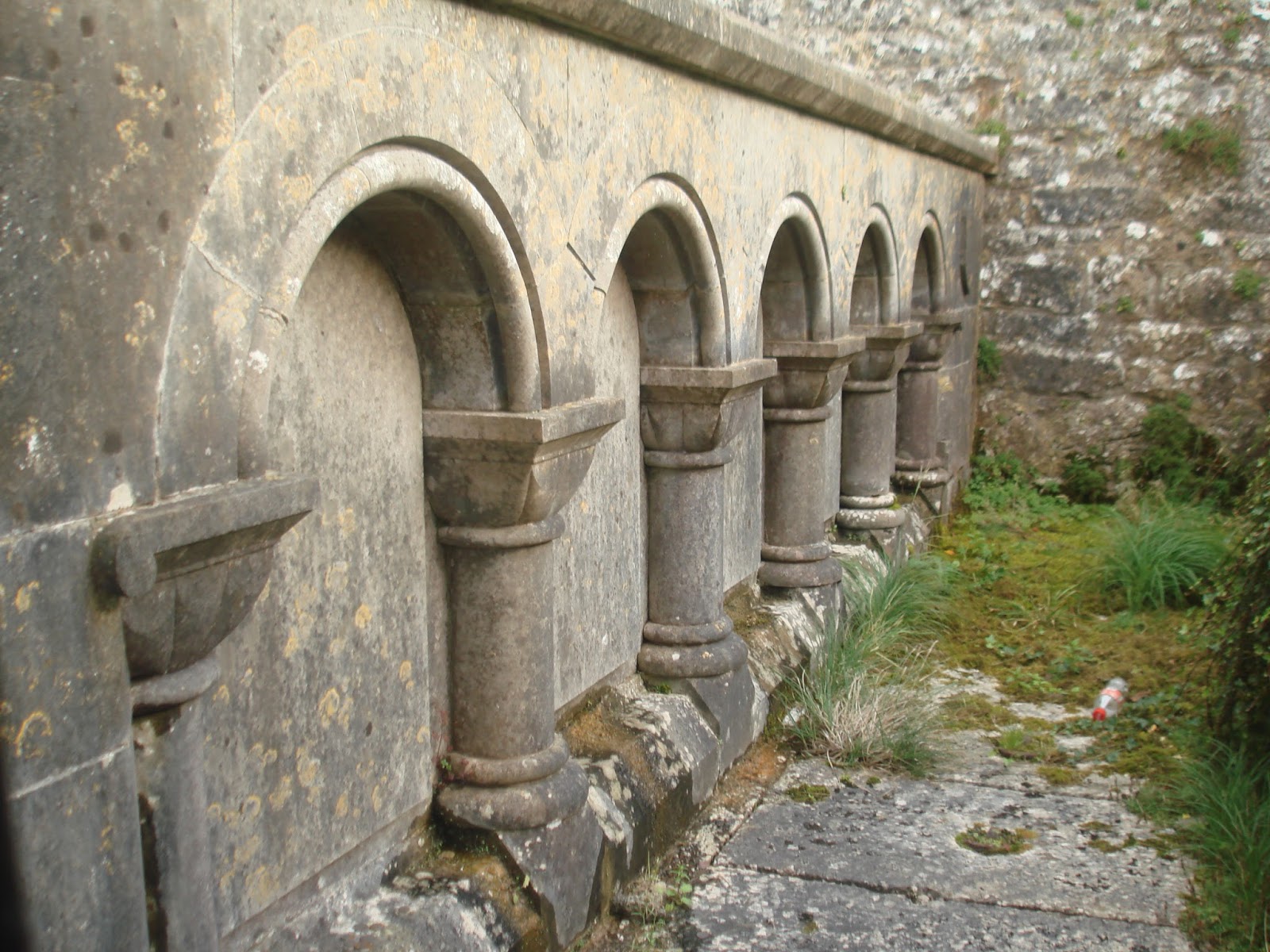
The stone arcade at the side of Teampull Connor


===============


Ground plan of Clonmacnoise by Peter Harbison 

===============

Lost churches

The standing remains at Clonmacnoise are not the whole story. The footings for Temple Kelly can be seen to the north of the cathedral. Old plans from the seventeenth to the nineteenth century show other churches, now long gone. These included Temple Gauny and Temple Espic along by the south boundary wall and Temple Killin to the east of Teampull Finghin and on the north boundary wall. [Tomas O Carragáin, Churches in early medieval Ireland (Yale University Press, 2010), p. 216]

Of course these lost churches were built of stone and it is unknown how many lost buildings were built of timber or wattle. 

================

Conclusion

On my 2016 visit I didn't get time to visit the Nunnery complex which is about 500 meters north of the main monastic site. One should always keep back another excuse to visit Clonmacnoise!


For further reading on Clonmacnoise the two volumes of seminar papers published in book form are highly recommended.


===============

End of post

===============